Featured post

What is a Data Anomaly? A Bike Shop Investigation

Introduction: Finding Clues in the Data

In the world of data, an anomaly is like a clue in a detective story. It’s a piece of information that doesn’t quite fit the pattern, seems out of place, or contradicts common sense. These clues are incredibly valuable because they often point to a much bigger story—an underlying problem or an important truth about how a business operates.

In this investigation, we’ll act as data detectives for a local bike shop. By examining its business data, we’ll uncover several strange clues. Our goal is to use the bike shop’s data to understand what anomalies look like in the real world, what might cause them, and what important problems they can reveal about a business.

——————————————————————————–

1.0 The Case of the Impossible Update: A Synchronization Anomaly

1.1 The Anomaly: One Date for Every Store

Our first major clue comes from the data about the bike shop’s different store locations. At first glance, everything seems normal, until we look at the last time each store’s information was updated.

The bike shop’s Store table has 701 rows, but the ModifiedDate for every single row is the exact same: “Sep 12 2014 11:15AM”.

This is a classic data anomaly. In a real, functioning business with 701 stores, it is physically impossible for every single store record to be updated at the exact same second. Information for one store might change on a Monday, another on a Friday, and a third not for months. A single timestamp for all records contradicts the normal operational reality of a business.

1.2 What This Anomaly Signals

This type of anomaly almost always points to a single, system-wide event, like a one-time data import or a large-scale system migration. Instead of reflecting the true history of changes, the timestamp only shows when the data was loaded into the current system.

The key takeaway here is a loss of history. The business has effectively erased the real timeline of when individual store records were last modified. This makes it impossible to know when a store’s name was last changed or its details were updated, which is valuable operational information.

While this event erased the past, another clue reveals a different problem: a digital graveyard of information the business forgot to bury.

——————————————————————————–

2.0 The Case of the Expired Information: A Data Freshness Anomaly

2.1 The Anomaly: A Database Full of Expired Cards

Our next clue is found in the customer payment information, specifically the credit card records the bike shop has on file. The numbers here tell a very strange story.

• Total Records: 19,118 credit cards on file.

• Most Common Expiration Year: 2007 (appeared 4,832 times).

• Second Most Common Expiration Year: 2006 (appeared 4,807 times).

This is a significant anomaly. Imagine a business operating today that is holding on to nearly 10,000 customer credit cards that expired almost two decades ago. This data is not just old; it’s useless for processing payments and raises serious questions about why it’s being kept.

2.2 What This Anomaly Signals

This anomaly points directly to severe issues with data freshness and the lack of a data retention policy. A healthy business regularly cleans out old, irrelevant information.

This isn’t just about messy data; it signals a potential business risk. Storing thousands of pieces of outdated financial information is inefficient and could pose a security liability. It also makes any analysis of customer purchasing power completely unreliable. The business has failed to purge stale data, making its customer database a digital graveyard of expired information.

This mountain of expired data shows the danger of keeping what’s useless. But an even greater danger lies in what’s not there at all—the ghosts in the data.

——————————————————————————–

3.0 The Case of the Missing Pieces: Anomalies of Incompleteness

3.1 Uncovering the Gaps

Sometimes, an anomaly isn’t about what’s in the data, but what’s missing. Our bike shop’s records are full of these gaps, creating major blind spots in their business operations.

1. Missing Sales Story In a table containing 31,465 sales orders, the Status column only contains a single value: “5”. This implies the system only retains records that have reached a final, complete state, or that other statuses like “pending,” “shipped,” or “canceled” are not recorded in this table. The story of the sale is missing its beginning and middle.

2. Missing Paper Trail In that same sales table, the PurchaseOrderNumber column is missing (NULL) for 27,659 out of 31,465 orders. This breaks the connection between a customer’s order and the internal purchase order. This is a significant data gap if external purchase orders were expected for these sales, making it incredibly difficult to trace orders.

3. Missing Costs In the SalesTerritory table, key financial columns like CostLastYear and CostYTD (Cost Year-to-Date) are all “0.00”. This suggests that costs are likely tracked completely outside of this relational structure, creating a data silo. It’s impossible to calculate regional profitability accurately with the data on hand.

3.2 What These Anomalies Signal

The common theme across these examples is incomplete business processes and a lack of data completeness. The bike shop cannot analyze what it doesn’t record.

These informational gaps make it extremely difficult to get a full picture of the business. Managers can’t properly track sales performance from start to finish, accountants struggle to trace order histories, and executives can’t understand which sales regions are actually profitable.

These different clues—the impossible update, the old information, and the missing pieces—all tell a story about the business itself.

——————————————————————————–

4.0 Conclusion: What Data Anomalies Teach Us

Data anomalies are far more than just technical errors or messy spreadsheets. They are valuable clues that reveal deep, underlying problems with a business’s day-to-day processes, its technology systems, and its overall data management strategy. By spotting these clues, we can identify areas where a business can improve.

Here is a summary of our investigation:

Anomaly TypeBike Shop ExampleWhat It Signals (The Business Impact)
SynchronizationAll 701 store records were “modified” at the exact same second.A past data migration erased the true modification history, blinding the business to operational changes.
Data FreshnessNearly 10,000 credit cards on file expired almost two decades ago.No data retention policy exists, creating business risk and making customer analysis unreliable.
IncompletenessMissing order statuses, purchase order numbers, and territory costs.Core business processes are not recorded, creating critical blind spots in sales, tracking, and profitability analysis.

Learning to spot anomalies is a crucial first step toward data literacy. It transforms you from a reader of reports into a data detective, capable of finding the hidden story in the numbers and using those clues to build a smarter business.

Featured post

Contemporary Debates in Sociopolitical and Scientific Terminology

A Briefing on Contemporary Debates in Sociopolitical and Scientific Terminology

Executive Summary

This post synthesizes analysis on two distinct but parallel terminological debates: the evolution and contestation of the term “woke” in sociopolitical discourse, and the long-standing scientific controversy surrounding the use of “entropy” in information theory.

The term “woke,” originating in African-American English to signify an awareness of racial prejudice, has expanded to encompass a broad range of progressive social justice issues. In recent years, it has become a focal point of the culture wars, co-opted by right-wing and centrist critics globally as a pejorative to disparage movements they deem performative, superficial, or intolerant. Within leftist thought, “wokeism” and identity politics are subjects of intense internal critique. Key arguments center on the concept of “elite capture,” where a professional-managerial class co-opts social justice for its own ends, and the fundamental tension between a focus on class-based universalism and identity-based particularism.

A similar, though more technical, controversy has surrounded Claude Shannon’s concept of “entropy” in information theory since the 1940s. A substantial body of evidence and expert opinion from physicists and thermodynamicists argues that Shannon’s use of the term is a misnomer with no physical relationship to thermodynamic entropy as defined by Clausius and Boltzmann. The term was adopted on the advice of John von Neumann, based on a superficial mathematical similarity and a joke that “nobody knows what entropy really is.” This conflation has been called “science’s greatest Sokal affair,” leading to decades of scientific confusion and a “bandwagon” of misapplication across numerous fields, a trend Shannon himself warned against. Proposed terminology reform, such as replacing “Shannon entropy” with “bitropy,” aims to resolve this foundational confusion.

1. The Evolution and Contestation of “Woke”

The term “woke” has undergone a rapid and contentious evolution, moving from a specific cultural signifier to a global political battleground. Its trajectory reveals key dynamics in contemporary social and political discourse.

1.1. Origins and Initial Meaning

The term is derived from African-American English (AAVE), where “woke” is used as an adjective equivalent to “awake.” Its political connotations signify a deep awareness of racial prejudice and systemic discrimination.

• Early Usage: The concept can be traced to Jamaican activist Marcus Garvey’s 1923 call to “Wake up Ethiopia! Wake up Africa!” The specific phrase “stay woke” was used by Black American folk singer Lead Belly in a 1938 recording of “Scottsboro Boys,” advising Black Americans to remain vigilant of racial threats.

• Mid-20th Century: By the 1960s, “woke” meant well-informed in a political or cultural sense. A 1962 New York Times Magazine article by William Melvin Kelley, titled “If You’re Woke You Dig It,” documented its usage. The 1971 play Garvey Lives!includes the line, “I been sleeping all my life. And now that Mr. Garvey done woke me up, I’m gon’ stay woke.”

1.2. Modern Popularization and Broadening Scope

The term entered mainstream consciousness in the 21st century, propelled by music, social media, and social justice movements.

• Music and Social Media: Singer Erykah Badu’s 2008 song “Master Teacher,” with its refrain “I stay woke,” is credited with popularizing the modern usage. The hashtag #Staywokesubsequently spread online, notably in a 2012 tweet by Badu in support of the Russian feminist group Pussy Riot.

• Black Lives Matter: The phrase was widely adopted by Black Lives Matter (BLM) activists following the 2014 shooting of Michael Brown in Ferguson to urge awareness of police abuses.

• Expanded Definition: The term’s scope broadened beyond racial injustice to encompass a wider awareness of social inequalities, including sexism and the denial of LGBTQ rights. It became shorthand for a set of progressive and leftist ideas involving identity politics, such as white privilege and reparations for slavery.

1.3. Pejorative Co-optation and Global Spread

By 2019, “woke” was increasingly used sarcastically by political opponents to disparage progressive movements and ideas. This pejorative sense, defined by The Economist as “following an intolerant and moralising ideology,” has become a central tool in global culture wars.

• United States: “Woke” is used as an insult by conservatives and some centrists. Florida Governor Ron DeSantis has built a political identity on making his state a place “where woke goes to die,” enacting policies like the “Stop WOKE Act.” Former President Donald Trump has referred to a “woke mind virus” and, in 2025, issued an executive order to prevent “Woke AI in the Federal Government” that favors diversity, equity, and inclusion (DEI).

• France: The phenomenon of le wokisme is framed by critics as an unwelcome American import incompatible with French republican values. Former education minister Jean-Michel Blanquer established an “anti-woke think tank” and linked “wokism” to right-wing conspiracy theories of “Islamo-leftism.”

• United Kingdom: The term is used pejoratively by Conservative Party politicians and right-wing media outlets like GB News, which features a segment called “Wokewatch.”

• Other Nations: The term has been deployed in political discourse in Canada (to discredit progressive policies), Australia (by leaders of both major parties), New Zealand (by former deputy PM Winston Peters), India (by Hindu nationalists against critics), and Hungary.

1.4. The “Woke Right” and “Woke Capitalism”

Recent discourse has identified two significant offshoots of the “woke” phenomenon:

• The Woke Right: A term used to describe right-wing actors appropriating the tactics associated with left-wing activism—such as “cancel culture,” language policing, and claims of group oppression—to enforce conservative beliefs.

• Woke Capitalism / Woke-washing: Coined by Ross Douthat, this term criticizes businesses that use politically progressive messaging in advertising for financial gain, often as a substitute for genuine reform. This has been associated with the meme “get woke, go broke.” Examples cited include campaigns by Nike, Pepsi, and Gillette.

2. Leftist Critiques of Identity Politics and “Wokeism”

The rise of “woke” as a political descriptor has been accompanied by a robust and multifaceted critique from within leftist, progressive, and Marxist circles. This internal debate centers on the relationship between identity, class, and the strategic goals of emancipatory politics.

2.1. The Central Debate: Class vs. Identity

A primary tension exists between advocates for a class-first universalism and those who prioritize the specific, intersecting oppressions related to identity.

• The Class-First Perspective: Proponents, such as Adolph Reed Jr. and Walter Benn Michaels (authors of “No Politics but Class Politics”), argue for a “politics of solidarity” over a “politics of identity.” This view holds that capital is the primary dynamic of oppression and that identity politics can distract from the universalist class struggle by dividing the working class. Some argue identity politics is rooted in idealism, which is incompatible with materialist Marxism.

• Critiques of Class Reductionism: This position is challenged by those who argue it overlooks forms of oppression that persist across class lines. One user pointed to the fact that “rich black women are still significantly more likely to die in childbirth than rich white women.” Another, identifying as trans, argued that the “extreme and toxic” vilification of certain minority groups requires a narrower focus, even if it is ultimately a tool of distraction used by the capitalist class.

2.2. Elite Capture and the Professional-Managerial Class (PMC)

A prominent critique argues that modern identity politics has been co-opted by a specific socioeconomic class.

• Key Texts: This critique is articulated in works like Olúfẹ́mi O. Táíwò’s “Elite Capture” and Catherine Liu’s “Virtue Hoarders: The Case Against the Professional Managerial Class.”

• The Argument: These thinkers posit that the PMC co-opts the language and goals of social justice movements, not for material change for the masses, but to consolidate its own cultural and economic capital. Catherine Liu’s broader argument is that critical theory academics have disconnected from both empirical data and Marxist political economy.

• A Sharper Critique: Adolph Reed Jr. criticizes Táíwò’s work as the “quintessence of neoliberal leftism,” arguing that it naturalizes and accepts elite capture and celebrates “performative radicalism” (like the Combahee River Collective and Black Lives Matter) while accepting its failure to produce substantive change in social relations.

2.3. Original Intent vs. “Identity Reductionism”

Several commentators distinguish between the original formulation of “identity politics” and its contemporary usage.

• The Combahee River Collective: The term “identity politics” was coined in the 1977 Combahee River Collective Statement. The original intent was materialist, viewing identity as a starting point for understanding one’s relationship to oppression and as a basis for coalition-building. It conceived of identity not as a static, essentialist category, but as a dynamic “process of becoming.”

• Contemporary Distortion: Critics argue that the current, “impossibly distorted version” of identity politics promotes “identity reductionism.” This modern form is seen as devolving into debates over who “has got the worst” and rejecting universalism in favor of an exclusive focus on particular subjectivities.

2.4. A Curated List of Critical Works

A Reddit discussion on this topic generated a comprehensive list of recommended literature, essays, and media from a leftist perspective critical of contemporary identity politics.

Author/Creator

Title

Notes / Mentioned In Context Of

Primary Critiques

Olúfẹ́mi O. Táíwò

Elite Capture

Co-optation by the professional-managerial class.

Catherine Liu

Virtue Hoarders: The Case Against the Professional Managerial Class

Critique of the PMC’s role in identity politics.

Adolph Reed & Walter Benn Michaels

No Politics but Class Politics

A central text for the class-first political argument.

Musa al-Gharbi

We Have Never Been Woke: The Cultural Contradictions of a New Elite

Nancy Fraser & Axel Honneth

Redistribution or recognition?: A political-philosophical exchange

Nuanced academic debate on the core tension.

Kenan Malik

Not So Black and White

Argues for politics of solidarity vs. politics of identity.

Susan Neiman

Left is not Woke

Vivek Chibber

Postcolonial Theory and the Spectre of Capital

Universalist Marxist critique of postcolonial theory’s culturalism.

Mark Fisher

“Exiting the Vampire Castle”

Critiques the “crabs in a barrel mentality” within leftist communities.

Christian Parenti

“The Cargo Cult of Woke” & “The First Privilege Walk”

Todd McGowan

Universality and Identity Politics

Wendy Brown

“Wounded Attachments”

Yascha Mounk

The Identity Trap

John McWhorter

Woke Racism

Controversial inclusion; McWhorter is considered right-wing by some.

Additional Works

Asad Haider

Mistaken Identity

Labeled “anti-idpol lite” by some commenters.

Eric Hobsbawm

“Identity Politics and the Left”

Norman Finkelstein

I’ll Burn That Bridge When I Get to It

Nancy Isenberg

White Trash

Discusses overlap of class and race. Critiqued as right-wing.

The Combahee River Collective

The Combahee River Collective Statement

The origin of the term “identity politics.”

Stuart Hall

“Who Needs Identity?”

A classic text on identity as a “process of becoming.”

Shulamith Firestone

The Dialectic of Sex: The Case for Feminist Revolution

Relates gender hierarchy to the material maintenance of capitalism.

J. Sakai

Settlers: The Mythology of the White Proletariat

Controversial; heavily criticized as replacing class with race analysis.

3. A Case Study in Terminology Confusion: Shannon “Entropy”

A decades-long debate in physics, thermodynamics, and engineering provides a compelling parallel to the semantic drift and confusion seen in sociopolitical terms. The controversy centers on Claude Shannon’s use of the word “entropy” in his foundational 1948 work, “A Mathematical Theory of Communication.”

3.1. The Central Argument: A Scientific Misnomer

The core thesis, articulated in the Journal of Human Thermodynamics and supported by numerous physicists and thermodynamicists since the 1950s, is that Shannon’s information “entropy” has “absolutely positively unequivocally NOTHING to do with” thermodynamic entropy. The conflation is described as a “farcical train of misconceptions” and “science’s greatest Sokal affair,” stemming from a coincidental similarity in the mathematical forms of the two concepts.

3.2. Dueling Origins and Definitions

The two concepts of “entropy” originate from entirely different scientific domains and describe fundamentally different phenomena.

Concept

Origin

Definition & Units

Thermodynamic Entropy

Formulated by Rudolf Clausius (1865) from the study of heat engines. Later developed by Ludwig Boltzmann and Willard Gibbs.

A physical state function related to heat transfer divided by temperature. Measured in joules per kelvin (J/K).

Shannon Entropy (H)

Developed by Claude Shannon (1948) from the study of telegraphy, signal transmission, and cryptography.

A mathematical function measuring choice, uncertainty, or information in a message. Measured in bits per symbol.

3.3. The 1940 Neumann Anecdote: Source of the Confusion

The historical record indicates that the terminological confusion was initiated by a conversation between Shannon and the mathematician John von Neumann around 1940.

• The Advice: When Shannon was deciding what to call his H function, von Neumann reportedly told him, “You should call it entropy, for two reasons. In the first place your uncertainty function has been used in statistical mechanics under that name. In the second place, and more importantly, no one knows what entropy really is, so in a debate you will always have the advantage.”

• The True Origin: The actual mathematical predecessor to Shannon’s formula was not Boltzmann’s work on thermodynamics but Ralph Hartley’s 1928 paper, “Transmission of Information,” which used logarithms to quantify signal sequences.

3.4. The “Bandwagon Effect” and a History of Warnings

Following the publication of Shannon’s 1948 paper, the idea of information “entropy” was widely and inappropriately applied to a vast array of fields outside of communications engineering, including biology, psychology, economics, and sociology.

• Shannon’s Warning: Alarmed by this trend, Shannon himself published a 1956 editorial titled “The Bandwagon,” urging restraint and warning that applying his theory to fields like psychology and economics was “not a trivial matter of translating words to a new domain” and that such work was often “a waste of time to their readers.”

• Decades of Dissent: A long line of scientists have issued similar warnings:

    ◦ Dirk ter Haar (1954): “[The] entropy introduced in information theory is not a thermodynamical quantity and that the use of the same term is rather misleading.”

    ◦ Harold Grad (1961): “The lack of imagination in terminology is confusing.”

    ◦ Kenneth Denbigh (1981): “In my view von Neumann did science a disservice!”

    ◦ Frank L. Lambert (1999): “Information ‘entropy’ … has no relevance to the evaluation of thermodynamic entropy change.”

    ◦ Ingo Müller (2007): “[The joke] merely exposes Shannon and von Neumann as intellectual snobs.”

3.5. Proposed Terminology Reform: “Bitropy”

To end the seven-decade-long confusion, the author of the source paper proposes an official terminology reform: replacing the name Shannon entropy with bitropy.

• Etymology: “Bitropy” is a portmanteau of “bit-entropy” or “bi-tropy.” It translates as the transformation (-tropy) of a choice between two (bi-) alternatives (bits) into information.

• Goal: The name change aims to permanently sever the false link to thermodynamics and “release a large supply of manpower to work on the exciting and important problems which need investigation,” as editor Peter Elias argued in a 1958 parody of the bandwagon effect.


Featured post

Synergy between today and yesterday

t

Synergy between today and yesterday

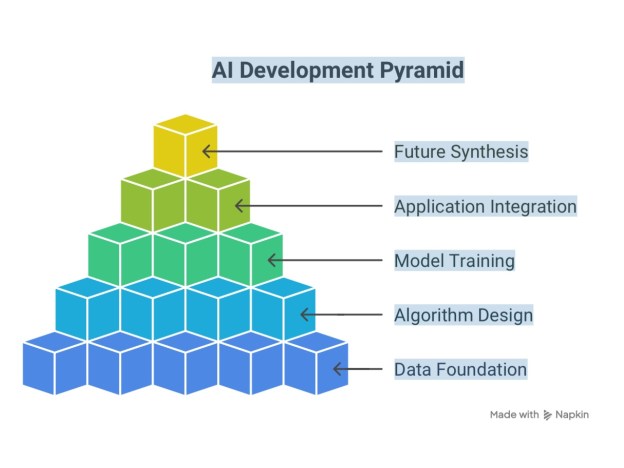
AI Pyramid of development Steps for synthesis of existing and future v

AI Development Pyramid

Future Synthesis

Application Integration

Model Training

Algorithm Design

Data Foundation

For the followings instructions samples provided upon request

Build Traditional Data. Warehouse

Identify requires fields Categorize into Required Dimension and statistics real world and

business

Establish Business Glossary Words Definition

Validate and context Alize

Load AI pModel with filling stepsAPPLY TO MODEL ,VIA RAG aeries OR FINE TUNE FOR SUBJECT KNOWLEDGE

Metric Goals Required stats from tools provided

Formula. Parts broken Down

Create with LLM Meta Prompts A Model guided and generated prompt)

System Developer & User via LLM

THIS WILL GENERATE APPS OR AGENTS

INCLUDE ROLE, SAMPLES WITH EVALUATIONS AND SCORIINGG

Featured post

Changes  and danger of losing weight too fast

Changes  and danger of losing weight too fast of course it’s only my experience and research counter intuititive  this most hapens to bariatric patients

Upon further reading I had a sudden realization that this had been happening to me for several years after I lost 80 pounds in 2021 I did not realize until this happened to my leg and arm in 2025 and it first happened to my throat in 2022 the slur it makes perfe sense number one was slurred throat. Then number two was brain fatique then number three was leg and finally number four was arm snd hand they are all going to the  Brustrom List 

sSages byall different lives or muscles This will technically happpen  too many people in the future as they eat right and lose weight. There are scientific studies that what has happened. basically I loweight  too fast and the nerves  around muscles and they compressed it will hea

Featured post

:A Personal Health Journey: Stroke Recovery and Weight Loss

: “A Personal Health Journey: Stroke Recovery and Weight Loss”

Source: Excerpts from “A Personal Health Journey: Stroke Recovery and Weight Loss” by Ira Warren Whiteside.

Date: (Implied, covering the period from 2014 to 2025)

Prepared For: (Intended audience, e.g., researchers, health professionals, general public interested in stroke recovery)

Subject: A personal account of stroke recovery and significant weight loss, detailing the timeline of events, symptoms experienced, and the author’s observations regarding the recovery process.

Executive Summary:

This document summarizes excerpts from Ira Warren Whiteside’s personal narrative of his health journey following an ischemic brainstem stroke in 2014. The account highlights a period of significant weight loss (155 pounds overall, including 80 pounds in one year starting in 2021) alongside the progression and eventual improvement of post-stroke symptoms. The author details the impact of dietary changes (cutting out sugar, seed oil, ultra-processed food, and alcohol) on his symptoms and mentions discovering the Brunnstrom stages of mobility recovery. A notable and seemingly counter-intuitive observation is the worsening of some neurological symptoms concurrent with weight loss, which the author links to a phenomenon observed in bariatric patients and supported by scientific studies, suggesting fat loss from nerves themselves. The narrative concludes with the author feeling recovery is finally occurring in 2025.

Key Themes and Most Important Ideas/Facts:

  1. Initial Stroke and Recovery (2014): The author experienced an ischemic brainstem stroke in 2014. He notes that he “recovered and [he] Still Worked and flew,” indicating a level of functional recovery in the initial period.
  2. Significant Weight Loss (2021-2022 & Overall): A major focus of the narrative is substantial weight loss. The author “lost 80 pounds in one year stared at 300 pounds” starting in 2021. Overall, he reports losing “155 pounds.”
  3. Dietary Changes and Symptom Progression: The author made significant dietary changes, “Cut out sugar and seed oil and all Ultra processed food and all alcohol.” He notes that concurrent with these changes and weight loss, his “Slur got worse.”
  4. Detailed Neurological Symptoms (2023): The account provides a list of neurological symptoms experienced, particularly intensifying in 2023, which the author describes as “Third year very bad.” These include:
  • “Nueral fajtque tiredness exhaustion” (repeated for emphasis).
  • “Pheneric. nerve breathing nerve referrred pain in shoulder.”
  • “Foot Drop got worse.”
  • “Elbow got worse.”
  • “Hand got worse.”
  1. Discovery of Brunnstrom Stages: The author mentions discovering the “Brunnstrom stages of mobility recovery,” indicating an engagement with understanding the process of neurological recovery.
  2. Unconventional Observation: Symptom Worsening and Nerve Fat Loss: A critical and perhaps surprising element of the narrative is the observed worsening of some neurological symptoms alongside significant weight loss. The author posits a connection, stating that the weight loss included “fat from [his] nerve i in leg and throat and arm.” He claims this phenomenon has happened to “many people bariatric patients” and is “Well documented. by scientific studies.” This suggests a potential link between systemic fat reduction and neurological function, particularly concerning nerve fat.
  3. Turning Point and Improvement (2025): The narrative concludes on a hopeful note, with the author stating that he is “Finally getting better. It makes sense.” This suggests a period of recovery and improvement is underway in 2025 after the difficult period described in 2023.

Important Quotes:

  • “2014 brainstem lStroke Ischemic I recovered and I Still Worked and flew”
  • “2021 lost 80 pounds in one year stared at 300 pounds”
  • “Cut out sugar and seed oil and all Ultra processed food and all alcohol”
  • “Slur got worse”
  • “Third year very bad”
  • “Overall one and lost 155 pounds”
  • “Including fat from my nerve i in leg and throat and arm”
  • “This happened too, many people bariatric patients Well documented. by scientific studies”
  • “2025 Finally getting better. It makes sense.”

Limitations:

It is important to note that this is a personal account and, as the author states, “My personal experience I’m not a doctor. This is not health advice only my knowledge and experience.” The narrative provides anecdotal evidence and personal observations. While the author references scientific studies regarding nerve fat loss in bariatric patients, the specifics of these studies are not included in the provided excerpts.

Further Considerations:

This account raises interesting questions about the complex interplay between metabolic changes (specifically significant weight loss) and neurological recovery after stroke. The observation regarding potential fat loss from nerves and its possible link to symptom fluctuation warrants further investigation and comparison with clinical data and research. The narrative could be a valuable starting point for discussions between patients and healthcare providers regarding the multifaceted nature of stroke recovery.

https://notebooklm.google.com/notebook/f68a3d00-f063-4cdb-be8c-fffefa6956a2/audio

Featured post

COMMON THEMES BETWEEN  THE BIBLE, WW2 , DOGE. Bible WWII and DOGE The Goverment Common Themes Bible WWII and DOGE Common Themes

The metaphor from the Bible to borrow from Peter to pay Paul is the basis of DOGE  ( Department of Government Expense) winning World War II unlike in times past  we can process the growing number  transactions and dispersing of money lightning speed with computers

The Genesis of computers includes work  in London to decipher German messages in the 1940s

In this effort, we matced letters here we matched the dollar amounts or totals we can find  them and find the match that’s called forensic auditing mini younger folks grew up with this technology

They e just need to feed it the transactions and it works on his own   They do not look at personal private information only amounts The mathematics   Are  centuries old only the speed that they  process has changed They may have to read the data several times, but eventually they’ll find the match. That’s why it takes more energy. You do not have to be a math. Genius just use currently available tools you cannot hide your child of transactions. Obviously, all  transactions can be traced This is not rocket science It is based on centuries  old logic. 

Featured post

What I have learned on my health journey.

What I have learned on my health journey.

Ira Warren Whiteside

I weighed 300 pounds four years ago  I am now 174 pounds definitely help me understand what message I need and what I don’t first inform of, I am no order, diabetic or insulin resisten are several other issues that have been resolved  The bottom line is you should not have seed oils /vegetable oils

First, I corrected what I eat no see seen oil and no added sugar

Also, no alcohol. Ever

I went too far. I tried carnivore for a year.

I went down to 155 that was too low and I lost it too fast my buddy now after four years it’s going through a reset. 

I am getting in healthier , but I believe I caused myself Slimmers Palsy rare nerve damage similar but different to a stroke and it will resolve with proper nutrition hy

However, I feel much better and I have no brain fog

This will resolve after sometime I know have a normal  weight and no other issues Healthy I am 69

Featured post

I’m in the making

Im in the making
Ira Warren Whiteside
Im 69
I’m a strokes victim
I have lost over 100 pounds
I’m not living in my past
I’m not thinking about my future
I’m in the now
I’ve come to know Carol widow
I’m a Ism in the making
Ira Warren Whiteside
Im 69
I’m a strokes victim
I have lost over 100 pounds
I’m not living in my past
I’m not thinking about my future
I’m in the now
I’ve come to know Carol
I’m a widow
My wife of 56 years passed away 4 years ago
The marriage vows contain the line “Till death do us part”
Carol and I have shared our thoughts and feelings
Over time we have climbed into our love
We have bonded
I say climbed not fell
Our love was made not just found
It was no accident
Ours was intentional
We havre obtained a peace
CD and love that we did not have before
To quote Carol “I’m an in the making”
We are engaged
My wife of 50 years passed away 4 years ago
The marriage contain the line “Till death do us part”
Carol and I have shared our thoughts and feelings
Over time we have climbed into our love
We have bonded
I say climbed not fell
It was no accident
Ours was intentional
We havre obtained a peace
CD and love that we did not have before
To quote Carol “I’m an in the making”
We are engaged

Ira “ Carols Beloved”

Featured post

Forgiveness – Merry’s. Wisdom

Inspired by Mary Wisdom

BRAVE, STRONG & HAPPY or THE GIFT YOU GIVE YOURSELFAugust 25, 2024May the words of my mouth and the meditation of my heart be acceptableto you O Lord, my rock and my redeemer. Amen.Romans 12:19 Do not take revenge, my dear friends, but leave room forGod’s wrath, for it is written: “It is mine to avenge; I will repay,” says theLord.I recently found a plaque with this saying.The 1st to apologize is the bravest.The 1st to forgive is the strongest.The 1st to forget is the happiest.These words really struck home with me. I think we can all benefit fromfrequent reminders of the importance to both apologize and forgive.

People who have a hard time apologizing frequently have an inflated egowhich gives them a sense of superiority. People who have a hard timeforgiving others, usually have a hard time forgiving themselves. There arethree things that reveal the depth of our relationship with God:The way we love people,the way we accept people andthe way we forgive people.1When we refuse to forgive another person, we put that person, andourselves, in bondage to our unforgiveness.We hear a lot about forgiveness, how God will forgive us if we ask, butwhat does that really mean? WHAT IS FORGIVENESS?

DEFINE FORGIVENESSto cease to feel resentment against (an offender)the act of forgiving somebody; the quality of being willing to forgivesomebodyBiblicalTwo types of forgiveness appear in the Bible: God’s pardon of our sins, andour obligation to pardon others. This subject is so important becauseour eternal destiny depends on it. God promises not to count our sins against us. Requires repentance (turning away from sin) and faith in JesusChrist. Willingness to forgive others is a condition for receivingforgiveness from God. It means pardoning offenses and letting go of resentment. Responding to wrongdoing with mercy rather than vengeance.The opposite of forgiveness is often considered to be resentment orvengeance.

The While forgiveness involves letting go of anger and the desire2for retribution, resentment involves holding onto those negative feelingsand seeking revenge. Seeking revenge could be as obvious as overtlytrying to hurt or destroy someone or as subtle as avoidance of someone, orlittle snide remarks about them.Mental and Emotional Benefits of Forgiveness1. Reduces Stress: Holding onto anger and resentment can increasestress levels. Forgiveness helps to release these negative emotions,leading to a more relaxed state of mind.2. Improves Mental Health: Forgiveness can reduce symptoms ofdepression, anxiety, and other mental health issues.3. Enhances Relationships:

Forgiving someone can improve yourrelationships by fostering trust and understanding.4. Increases Happiness: Letting go of grudges can lead to a morepositive outlook on life and increase overall happiness.Physical Benefits1. Lowers Blood Pressure: Reducing stress through forgiveness canhelp lower blood pressure.2. Improves Heart Health: Forgiveness has been linked to better hearthealth and a lower risk of heart disease.3. Boosts Immune System: A positive mental state can strengthenyour immune system, making you less susceptible to illnesses.34. Reduces Pain: Some studies suggest that forgiveness can lead to areduction in chronic pain.Social Benefits1. Builds Empathy: Forgiving others can help you develop a greatersense of empathy and compassion.2. Promotes Reconciliation: It can pave the way for reconciliation andhealing in relationships.3. Creates a Positive Environment: Forgiveness can contribute to amore positive and supportive social environment.Forgiveness is a powerful tool for personal growth and well-being. Is therea particular situation you’re thinking about where forgiveness might bebeneficial?I think generally people would rather be happy and at peace with thosearound them rather than stressed out, frustrated, angry or dismissive. Yet Ialso know that the people who are stressed out and angry have made achoice to be that way. Probably they don’t realize that’s the choicethey’ve made, but they have. Most people who are stressed out & angrybelieve it is a person or set or circumstances that cause them to have thisnegative anxiety.People do and say things that make us angry. Fact of life. Things happenthat are not fair and make us angry or frustrated. Fact of life. Many times,we have no control situations that make us angry, or stress us out. Fact oflife. We do, however, have control how we react to these negative4situations. Gad gave us free will, but free will is not free. The choiceis ours to hang onto the injustice and all the negative feelings it created, orto determine what we can learn from that situation, or about that personthat wronged us, and move on to more positive things in life.I remember a long time ago, listening to a teenager complain about asituation at school where he felt he was being treated unfairly. Quitehonestly, I don’t remember the specific details of the incident, but decadeslater I do remember how angry this person was for quite a long time..Even after more than a week had passed, his anger was still boiling over.Any attempts I made to talk to him about the situation and diffuse the angerwere met with hostility or rejection, and the comment. “What happenwasn’t right, it wasn’t fair. Don’t I have a right to be angry?”Now I need to let you know that this person had very little knowledge aboutGod’s desire to forgive us and for us to forgive others. He thought that anymention of God was ‘sissy stuff’ that really had no bearing on the real worldwe live in. He had not been brought up going to church; nor had he or hisfamily made lifestyle choices that would be pleasing to God. They weren’treally ‘bad people’.. just good people doing bad things, without thinkingthere were any negative consequences to negative behavior. They wereliving completely in this temporary material world; aware only of thephysical things that were either pleasing or not pleasing. They werepeople who didn’t think God was very important to them. That there wasnothing beyond this life.We have a CHOICE to be angry or not. Hanging on to an unjust situationis only detrimental to ourselves. Nothing good can come from it.5Mark Twain said “ Anger is an acid that can do more harm to the vessel inwhich it is stored than to anything on which it is poured,”“Forgiveness is not an occasional act, it is a constant attitude.” ―Martin Luther King Jr.”Always forgive your enemies – nothing annoys them so much.” -Oscar WildeSCRIPTURE ABOUT FORGIVENESS….Colossians 3:13 “Bear with each other and forgive one another if any ofyou has a grievance against someone. Forgive as the Lord forgave you.”Think back to King David, the sins he committed. In trying to cover themup or hide them he committed more sins. He did not see the need to askGod to forgive him for the terrible things he had purposely done. Godhates sin, so David was punished. When David realized how angry Godwas with him, he was able to truly repent. Only then was he able to riseabove the pain & suffering his actions had caused, and find peace.(Mark 11:26) “If you do not forgive neither can my Father forgive you.Matthew 6:14-15 “For if you forgive other people when they sin againstyou, your heavenly father will also forgive you. But if you do not forgiveothers their sins, your father will not forgive your sins.”This reason alone is good enough reason why we should forgive others,even though we find it to be very difficult thing. When you consider how6much more important God forgiving you is in comparison to the wrongsomeone does you, it should be a no brainer. Without God’s forgivenesswe are doomed to spend eternity in hell. The sin of not forgiving othersplaces a barrier between ourselves and God.The Need for us to forgive others is just as important as the need forGod to forgive us.We don’t forgive people to change them or how they act. We forgivepeople to cleanse ourselves of the pain & suffering their actions havecaused us….I know a lot of people who have a very hard time in forgiving others.What could be ONE reason why we have a hard time forgiving others whohave hurt us? Usually because we have a hard time forgiving ourselves.Remember that what we see in the world around us usually mirrors whatand how we feel about ourselves. People who see more negative thingsin this world than good are frequently stressed because there’s a pieceinside them that is either damaged or missing. Many times these peoplecan’t see the love others have for them because they rejected the love Godwants to pour into them.In order to change that negativity we need to start looking at the worlddifferently. We need to start looking at the people in our lives differently.That can only happen when our relationship with God changes. When weembrace God’s unconditional love for us, we can then start to love people,7accept them (flaws and all), and not judge them for their mistakes. Then,and only then can we truly forgive them. Then, all those negative, badfeelings will no longer be part of who we are. They will be gone. We willbe set free. That should be our goal – to get rid of the feelings that causeus emotional.STORY – There was a person I used to have to work with that knit pickedeverything to death. The meetings we had were very stressful, not just formyself but for others. For the sake of this story, let’s call this woman Sally.Now Sally was a very intelligent, well-educated person with lots of gifts,one of them being a lot of financial resources. She did a lot with theseresources, was generous to the church and others. But these gifts alsogave her a very large ego. She frequently tried to intimidate others to gethet point across, or convince others that her ideas were better than theirs.Well, you get the idea. It seemed like she took pleasure in theseconfrontations with people. I found myself dreading interactions with her,as I would only remember the hurt & anxiety I felt around her. Feelings Ididn’t like to feel. So I started to examine why I felt this way and how Icould change how I felt. Certainly I couldn’t change her or her behavior,but I could change how I felt about her.After lots of prayer, studying scriptures about forgiving others I was finallyable to see her differently. It’s like someone turned the light on. Here wasSally, a God loving generous person who was flawed (just as you & I areflawed). Nothing more, nothing less. It was after this revelation that I wasable to accept her flaws and not have them upset me. I was focusing onthe many gifts she was sharing with others instead of her flaws. I was8able to look at her in a way similar to how God looks at us. He doesn’tfocus on our flaws; he see the good inside each of us.I remembered a quote from Oscar Wilde“Always forgive your enemies, nothing annoys them so much”Being human and, flawed I’ll admit that to this day I still take pleasure inremembering this quote.Try ‘killing with kindness’ – that’s something I still take great pleasure in -it gives me a sense of power knowing that people cannot provoke me. Myactions in negative situations remain positive, and hopefully pleasing toGod.Luke 23:24 “Father, forgive them, for they know not what they ae doing.”It still amazes me how powerful this short scripture is. “Father, forgivethem, for they know not what they ae doing.”Why is forgiving so important? Carrying around all that anger & hurt isdamaging us more than we often realize. First and foremost it puts abarrier between God and ourselves.To be a Christian means to forgive the inexcusable because God hasforgiven the inexcusable in you.C. S. Lewis9CONCLUSION Holding on to anger and resentment can be a very painfuland potentially harmful process. Author Stephen Hayes writes“Unforgiveness is like being on a giant hook. Next to the hook is theperson who has hurt you. The hook is extremely painful. Everywhere yougo, so does the hook and so does the offender, The only way you can getoff the hook is if you allow the offender off first, The cost of not allowingthe offender off the hook is, perhaps a lifetime of unhappiness. Don’t put awall between you and the love God is offering you.Remember: The 1st to apologize is the bravest, the 1st to forgive is thestrongest, and the 1st to forget is the happiest. AMEN

Featured post

Stroke Weight Loss Polyneuropathy Recovery

Of course this is my own opinion and experience

It also about the importance of decimating of information in the facts or twisted statistics in is based on i’m looking at you pharmaceutical industry , food, industry an government b

In 2020 I weighed almost 300 pounds. I now weigh 175

2020. I took many medications, take none.

In 2019 I begin to understand and research nutrition with Vic ,my daughter).and reconnected with my best friend Jordan

I am a Data Governance, consultant and very experienced in the difference between information and data I also work in intelligence  and data science

However, slowly, but my health has returned

2014. I had a Stroke I mostly recovered.

However, this is about Polyneuropathy of voice and balance, it’s the bodies natural reaction to change and adaption

I lost over 50% of my body weight and I can barely speak and balance. This is normal and counter intuitive.

My speech and balance can be healed however, that will take me several years

I am posting this because I don’t feel many don’t realize how the body and brain works.

This is not intuitive. I would think I’m getting worse however I am really getting much much better.

Seems kind interior but I would not trade the way I can take now for speech or balance

Of course my daughter Victoria started me on his journey and supported me all the way

Bottom line is while. This is about health and nutrition. It’s also about stroke recovery and the importance and change that nutrition can. Bring

More to come . .

2018
202;4

Featured post

Welcome to a new world Social Networks & AI will expose facts and thereby reality

The resulting life for us will be better

People for the last decade have been using social networks to a store they started snow is getting bigger tooth is coming out

Now that we have AN soon AGI these new algorithms or respond to what’s really happening on the ground no necessarily media

AI, started in the financial markets they don’t respond to media. They respond to reality and facts on the ground.

Featured post

DON’T argue with Donkeys

Fable: DON’T ARGUE WITH DONKEYS

The donkey said to the tiger:

  • “The grass is blue”.

The tiger replied:

  • “No, the grass is green.”

The discussion heated up, and the two decided to submit ohim to arbitration, and for this they went before the lion, the King of the Jungle.

Already before reaching the forest clearing, where the lion was sitting on his throne, the donkey began to shout:

  • “His Highness, is it true that the grass is blue?”.

The lion replied:

  • “True, the grass is blue.”

The donkey hurried and continued:

  • “The tiger disagrees with me and contradicts and annoys me, please punish him.”

The king then declared:

  • “The tiger will be punished with 5 years of silence.”

The donkey jumped cheerfully and went on his way, content and repeating:

  • “The Grass Is Blue”…

The tiger accepted his punishment, but before he asked the lion:

  • “Your Majesty, why have you punished me?, after all, the grass is green.”

The lion replied:

  • “In fact, the grass is green.”

The tiger asked:

  • “So why are you punishing me?”.

The lion replied:

  • “That has nothing to do with the question of whether the grass is blue or green.

The punishment is because it is not possible for a brave and intelligent creature like you to waste time arguing with a donkey, and on top of that come and bother me with that question.”

The worst waste of time is arguing with the fool and fanatic who does not care about truth or reality, but only the victory of his beliefs and illusions. Never waste time on arguments that don’t make sense…

There are people who, no matter how much evidence and evidence we present to them, are not in the capacity to understand, and others are blinded by ego, hatred and resentment, and all they want is to be right even if they are not.

When ignorance screams, intelligence is silent. Your peace and quietness are worth more. 🤎

Featured post

AI – your business already has projects underway for the most important part and aspect of AI and it’s not technology

With increased knowledge, frankly, you can, reuse, and leverage, train AI with data you already have however, the most important essay is was and will be Quality, fact. And you don’t need to purchase special proprietary, IP or vendor programs to take advantage. Do you need it to be untangled explain in the mystify it’s not marketing crap it’s the real world

You have the foundation for AI already in your ability, you may not know broadly that is AI is solely based on data, standardization, profiling, quality in essence, statistics because that’s what makes information , we already have it and more importantly, it can be accomplished by your own developers or regular consultant, contractors, contractors.

It’s only the AI algorithm and algorithms that you may need some guidance and use open source. More importantly, even if you decide to buy a proprietary AI model, there are numerous open source models that you can build or prototype making sure you have the correct information, data assumptions and Hokies bill to make a meaningful model.

“You get what you inspect, not what you expect” There are many skilled people and resources that can build and validate the foundation for your Company without knowing much about in the beginning stages, the emphasis should be on business requirements and data quality before anything else weather Data Governance or AI.

It’s the same it’s start with understanding your own information or data. AI the Data quality principles that we used are still the same and they hold.

I will be posting and scheduling a free brief webinar to hopefully demystify this going forward. AI is a evolution is not revolution there’s no magic. although I will add that one major impact of AI is it can used in and reducing the cost and time for data governance and data stewardship

Featured post

3 Minute AI School Bytes Episode 2 Correlation versus Causation

3 Minute AI School Bytes Episode 2 Minute AI School Bytes Episode 2Hi
Artificial intelligence , define correlation or causation , a very important difference
Artificial intelligence stems from a concept invented by Alan Turing during his work with The Bomb , an early computer , in World War II. Needless to say, there are many aspects of today’s AI. However, most of them are driven by various features and math formulas.
Ultimately, I mean data fields ,are the primary drivers of AI and the concept of correlation or causation . In essence, they are represented in the graph by a line pointing upward or down a trend , if you involve two features , let’s say, in the same general direction of the other arrow, and, there is another arrow adjacent to it in the same general direction up or down that can be interpreted either as correlation or causation, This is important in all fields , meaning that just because two things are happening and going in the same direction , or trend , they are correlated, but it’s does not mean one is causing the other , this is critical to understand , as a sidenote we have made this mistake in history and science many times.


Of course this is another reason to base your science on standardized verified , human curated, information not just raw data ,or data, manipulated by algorithms to make them, conform to a model usable by AI. As you see from the diagram , including melting ice cream, it’s not the cause of a sunburn it is simply correlated.


Ira
Featured post

My Stroke, My Life, My Daughter Victoria – Update 2025 – 10 years later, Self Governance for Health

I don’t want to bother you, however, I’d like to give you some info new to me and a recent surprising discovery.

In no way, I don’t mean this to be TMI however, you should know what you can find out yourself

Health update, 9 years post stroke after losing extreme amount of weight and changing my diet. On June 3, 2014 I had a brain stem stroke(PONS). Apparently I’m still alive

I’ve posted some Of this on Facebook, i’d like to add some more findings, discoveries and changes in my life. Let me say unequivocally there have been two women in my life with me life that are at the center the first my wife, Teresa Krebs and of course, my daughter, Victoria Stasiewicz

My wife Theresa passed several years ago, and I’d have reconciled that event

I have met an amazing engaged to Caro However, since then there has been some fantastic news and surprising in some new challenges. Due to the stroke and my health improvement and, of course, Victoria

In the time I spent with my daughter and son-in-law in their home, my daughter gave a presentation regarding self governance for Health. This would come to be be a turning point in my life

The main premise is that with today’s tools and health devices, we can monitor our health very scientifically and accurately without a doctors intervention, or interpretation The conditions I suffered from were due to the food I ate and my lifestyle, no, DNA. It was not destined to happen I caused them, hence self governance. – Health..

Following Victoria‘s advice and counsel I am in very good health now. I have metabolic readings of it again that took myself, I can see for myself

I have lost over 100 pounds in the last 4 years. I didn’t go on extreme diet I just ate whole natural foods an actual proper human diet ,based on my daughters advice. In addition to that my blood pressure condition and diabetes2 went away, my eyeball shots and everything else went away in general. My health has now completely back to normal .

I have embraced her proposal, and would like to outline the results following

In addition when I started 280 pounds almost 300 I had high blood pressure, I had retinopathy in both eyes requiring two shots in each eye every six weeks I had early stage, kidney disease, and all the other medical problems associated

Also, I took several medication every day for these conditions last two years no medication’s at alli

Along this journey, I’ve also done thousands of hours of research, and like many millions of folks, I have discovered, and proven that Victoria‘s advice was perfect and well thought out

Now for “the rest of the story“ I am currently dealing with balance issues and speech issues basically, my brain did a reset because of the drastic changes in my health for the better frankly due to Neuro plasticity, I will recover it is important to realize the doctors will believe my condition is worse that is farthest from the truth, it has much I realize it’s with their training, It is an anomaly my losing weight and regaining health. I even had one doc say it was probably Cachexia – Muscle wasting However, it is not my blood work is fine is that they have not seen this as a result of the stroke rather not a person wanting to improve their health hallucinate

It took me a while to research that, but what is surprising is that they are both good news

Both caused by a conditions,known as stroke decomposition and vestibular dizziness

I suffered a stroke in 2014 right Pons Brain stem stroke my brain adapted with neural plasticity over last 10 years and I adapted to my disabilities, although I was continuing to degrade my health and weight through improper nutrition

Basically, I’ve confused my brain because it was used to that I weighed over 300 pounds. I know weigh 155 pounds. Hence, I have some balance and speech issues due to stroke, decomposition, and vestibular dizziness

I am writing this, only to let people know that our current medical professionals are not equipped to treat us. Losing this much weight while, surviving from a stroke has it complications

This is not me getting worse. This is me getting better. Through Neuro plasticity my brain will adapt normally.

One very positive result is a now thinking and working like I did 20 years ago and incredible impact on my health has been the returning logical thinking . There are more results to eating real Whole Foods, then you realize As of three years ago, I eat only natural food

of course no sugar or alcohol or any processed food The reality is, it’s not worth it Perhaps if I would’ve known, I paid tension to the real Risk no the relative rest to Ted to see this with marketing and pharmaceuticals I would know how to continue obviously no amount of sugar, processed food or alcohol is worth stroke

There is much more to my learnings

. I would leave you with that. I’m still working as a data, governance consultant and writing books, and the improvement in my ability to think and cognition is incredible. There are many more benefits that come from Self governance– Health which I will outline in the future7Z

But let me just say that in today’s society, there is a huge difference between “follow the science“ and real truth more important facts What Victoria has told me that today’s science, his interpretation by doctors with Me and will change overtime. However, you can see your own results make your own injections at least understand what you’re seeing versus just believe, having faith is important, but equally it is important to “trust, but verify”

That’s it right now. Thank you. Obviously, I will be going to the doctors but I will know what to expect. you get with you Inspect not what you expect and finally, obviously, the people closest to you and your life’s journey really matter

Featured post

Information Value Chain Story

I’d would like to discuss the information, value chain and how we interpret information. However since your here and, we have time , we don’t make decisions based on data or transactions we make decisions based on information, which is in essence thru visualization and trends,, which is the result of calculations, summarizations visualization of a tremendous volume of data.

It is an is important distinguish between data and information. our perception of reality and the information we make decisions on is based on, whether or not it is accurate. Information, quality or scoring often determine how far we would go. We don’t look at the detail, we don’t want to or can’t comprehend or understand, the detail of the information we want to understand trends that will lead us to decisions to change the trends. In the next article we will examine a client I had, and which I took this journey with much detail however, the focuses on high-level impactful decision

The Takeaway is that you need to understand causality not correlation you need to understand why things happen in essence. I in brutal honesty, which is that you understand what things you can change vs thing you can’t change how you gonna affect your future reaching your goal. We will be exploring this in detail step-by-step.

Featured post

Data Governance – Navigating the Information Value Chain

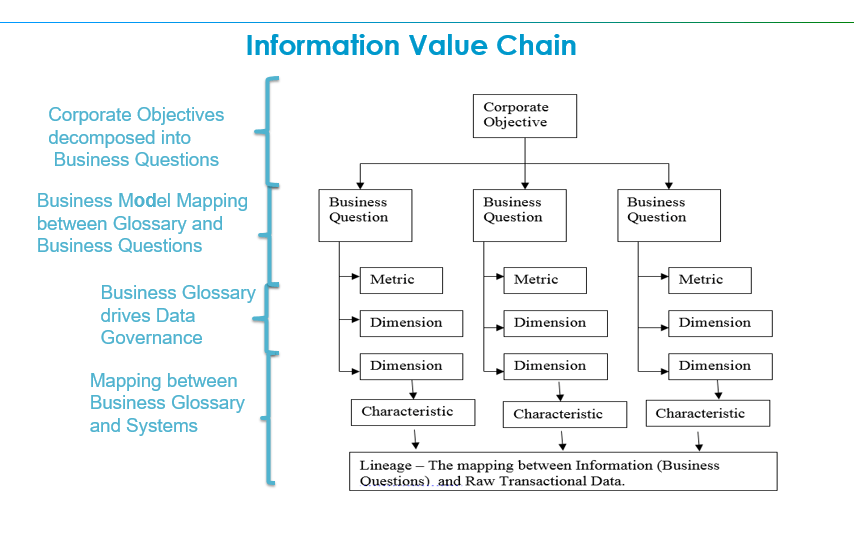
The challenge for businesses is to seek answers to questions, they do this with Metrics (KPI’s) and know the relationships of the data, organized by logical categories(dimensions) that make up the result or answer to the question. This is what constitutes the Information Value Chain

Navigation

Let’s assume that you have a business problem, a business question that needs answers and you need to know the details of the data related to the business question.

Information Value Chain


  • Business is based on Concepts.
  • People thinks in terms of Concepts.
  • Concepts come from Knowledge.
  • Knowledge comes from Information.
  • Information comes from Formulas.
  • Formulas determine Information relationships based on quantities.
  • Quantities come from Data.
  • Data physically exist.

In today’s fast-paced high-tech business world this basic navigation (drill thru) business concept is fundamental and seems to be overlooked, in the zeal to embrace modern technology

In our quest to embrace fresh technological capabilities, a business must realize you can only truly discover new insights when you can validate them against your business model or your businesses Information Value Chain, that is currently creating your information or results.

Today data needs to be deciphered into information in order to apply formulas to determine relationships and validate concepts, in real time.

We are inundated with technical innovations and concepts it’s important to note that business is driving these changes not necessarily technology

Business is constantly striving for a better insights, better  information and increased automation as well as the lower cost while doing these things several of these were examined

Historically though these changes were few and far between however innovation in hardware storage(technology) as well as software and compute innovations have led to a rapid unveiling of newer concepts as well as new technologies     

Demystifying the path forward.

In this article we’re going to review the basic principles of information governance required for a business measure their performance. As well as explore some of the connections to some of these new technological concepts for lowering cost       

To a large degree I think we’re going to find that why we do things has not changed significantly it’s just how, we know have different ways to do them.

It’s important while embracing new technology to keep in mind that some of the basic concepts, ideas, goals on how to properly structure and run a business have not changed even though many more insights and much more information and data is now available.

My point is in the implementing these technological advances could be worthless to the business and maybe even destructive, unless they are associated with a actual set of Business Information Goals(Measurements KPI’s) and they are linked directly with understandable Business deliverables.

And moreover prior to even considering or engaging a data science or attempt data mining you should organize your datasets capturing the relationships and apply a “scoring” or “ranking” process and be able to relate them to your business information model or Information Value Chain, with the concept of quality applied real time.  

The foundation for a business to navigate their Information Value Chain is an underlying Information Architecture. An Information Architecture typically, involves a model or concept of information that is used and applied to activities which require explicit details of complex information systems.

Subsequently a data management and databases are required, they form the foundation of your Information Value Chain, to bring this back to the Business Goal. Let’s take a quick look at the difference between relational database technology and graph technology as a part of emerging big data capabilities.

However, considering the timeframe for database technology evolution, has is introduced a cultural aspect of implementing new technology changes, basically resistance to change. Business that are running there current operations with technology and people form the 80s and 90s have a different perception of a solution then folks from the 2000s. 

Therefore, in this case regarding a technical solution “perception is not reality awarement is”. Business need to find ways to bridge the knowledge gap and increase awarement that simply embracing new technology will not fundamentally change the why a business is operates , however it will affect how.

Relational databases were introduced in 1970, and graph database technology was introduced in the mid to 2000

There are many topics included in the current Big Data concept to analyze, however the foundation is the Information Architecture, and the databases utilized to implement it.

There were some other advancements in database technology in between also however let’s focus on these two

History

1970

In a 1970s relational database, Based on mathematical Set  theory, you could pre-define the relationship of tabular (tables)   , implement them in a hardened structure, then query  them by manually joining the tables thru physically naming attributes and gain much better insight than previous database technology however if you needed a new relationship it would require manual effort and then migration of old to new , In addition your answer it was only good as the hard coding query created

2020

In  mid-2000’s the graph database was introduced , based on graph theory, that defines the relationships as tuples  containing nodes  and edges.  Graphs represent things and relationships events describes connections between things, which makes it an ideal fit for a navigating relationship. Unlike conventional table-oriented databases, graph databases (for example Neo4J, Neptune) represent entities and relationships between them. New relationships can be discovered and added easily and without migration, basically much less manual effort. 

Nodes and Edges

Graphs are made up of ‘nodes’ and ‘edges’. A node represents a ‘thing’ and an edge represents a connection between two ‘things’. The ‘thing’ in question might be a tangible object, such as an instance of an article, or a concept such as a subject area. A node can have properties (e.g. title, publication date). An edge can have a type, for example to indicate what kind of relationship the edge represents.

Takeaway.

The takeaway there are many spokes on the cultural wheel, in a business today, encompassing business acumen, technology acumen and information relationships and raw data knowledge and while they are all equally critical to success, the absolute critical step is that the logical business model defined as the Information Value Chain is maintained and enhanced.

It is a given that all business desire to lower cost and gain insight into information, it is imperative that a business maintain and improve their ability to provide accurate information that can be audited and traceable and navigate the Information Value Chain Data Science can only be achieved after a business fully understand their existing Information Architecture and strive to maintain it.

Note as I stated above an Information Architecture is not your Enterprise Architecture or even Data Architecture Information Relationships it is the hierarchical design of shared information environments; the art and science of organizing and labelling gGossary terms, transactions to support usability and findability; in an emerging community of practice focused on bringing principles of design, architecture and information science to the digital landscape. Typically, it involves a model or concept of information that is used and applied to activities which require explicit details of complex information systems.

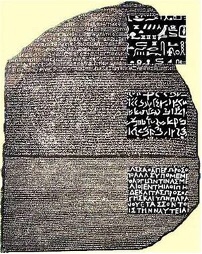
In essence, a business needs a Rosetta stone in order translate past, current and future results.

Rosetta Stone

In future articles we’re going to explore and dive into how these new technologies can be utilized and more importantly how they relate to all the technologies.


Featured post

Trial and Tribulations of MDM (Coming Soon)

Ira Whiteside / Jordan Martz / Victoria Stasiewicz

Advanced Matching for Business Categories(Terms) to Technical Artifacts(Data) in Relation to Master Data Management Governance and or Feature Engineering in Artificial Intelligence Modeling preparation.

We will be covering a top down(Business) and bottoms up Business driven methodology and tactical capabilities to the critical issue of associating Business categories/ dimensions to each other and subsequently transactions. We will include templates and code (Python/SQL/Databricks,etc…)….

Featured post

Eat to LIVE , do not live to EAT

My journey to better health and the rest of my life, MINUS ==== 85 pounds, eyeball shots(needles), blood pressure meds, diabetes , they are all gone.

Pre Victoria
POSTVictoria

The ending and the beginning

It’s August 27, 2020 I’m 66 years old, and in very bad health..  My wonderful wife Tessie, passed away last night surrounded by her daughters and her grandchild.  I’m contemplating where to go from here I weigh 280 pounds, I get  Avastin shots in my eyes every six weeks,  I take blood pressure medications,  I take cholesterol medication walking is very difficult , I walk with a cane(BubbaStik).  I’ve have Diabetes Type II had two strokes, I get severe IBS(Irratible Bowel Syndrome) attacks.  I am still working , barely, Brandon and Victoria graciously take me in their home.

The beginning

In the beginning I started by just eating what Victoria ate meat, fish, salad, low carb.  Obviously I was very depressed.

Holy shit

I realize I lost 20 pounds in three months. I get laid off from work.

Really

With Brandon and Vics encouragement I start a new consulting business.

I realize I’ve lost 75 pounds in six months

PERCEPTION is not reality, AWAREMENT is reality. More on our understanding on food and the dangers of following the food pyramid recommendations

I did not go on  a diet my daughter has an approach to nutrition, Victoria’s Self Governance for health. I began to study nutrition with Vic deeper and started eating more whole foods, UNPROCESSED meat, fat, and still some vegetables what I would consider normal human food than 10,000 years ago, I didn’t count or measure anything.

Perception vs. reality

I have researched nutrition extensively and have realized that the current food pyramid guidelines are ass backwards and inverted. I will lay out the details in a later post.

Acceptance

What now. I have started  a new consulting business, Brandon and Vic , my grandaughter Julia and best friend Jordan. Vic and Brandon got me a racing Terratrike , and I am moving in an apartment. We’ll see where we go from here.

Note: Yes I still drink Red Wine – Coppolla Claret

With ICE

Featured post

Cancer cannot be cured, “remission” is b#llsh#t, but you can LIVE and LOVE. “Perception is not reality, awarement is reality.”

My soulmate, my wife, my “partner“ the absolute love of my life passed away last year., NEEDLESSLY. Tessie and I put our faith in our doctors and Tessie as it should be put her faith in me, and I failed her. I didn’t cheat on Tess, I didn’t gamble, I didn’t lie, although I did drink too much, however every second of every day I feel I feel I failed.

Tessie and I survived the first occurrence of cancer in 2009. Once Tess was diagnosed she was able to take advantage of Avastin at the time a new type of immunotherapy., primarily because her idiot husband did not have insurance. Which the doctors credited with putting Tessie‘s cancer into remission, that was BULLSHIT. Eight years later I’m doctors in our regular visit told Tessie she was fine doing well and there were no signs of cancer, that was bullshit. 9 years later Tessie experienced sever back pain and was told she has sciatica, 10 years later Tessie and I were in the emergency room and it was discovered the test had multiple tumors kidney liver back ….

17 months later after much suffering and pain and at this point multiple tumors, my incredible wife passed away, and I feel as her husband.

As of today in 2021, cancer occurs in our bodies at the DNA levels. We’re told and led to believe that the issue of cancer is tumors, however it’s more basic than the issue was cancer is that are mRNA, copies are DNA to create new cells and when those cells are created they’re not coded with an expiration date. It isn’t widely known but our bodies create approximately 259 billion cells every day and in general they live only for three days, and then they die with the preschool describe date, If they don’t die, they form tumors and that is cancer.

The reason I say, that I feel I failed Tessie., is that if we would’ve not a relied on doctors and not relied on PURLEY faith and her husband would’ve done more research and realize that the only way to live longer with cancer, I emphasize the only way is to monitor and be aware of certain very low levels of substances that are accumulating in her body that can be tracked with things called cancer marker test, which generally are blood Tess’s case there is a very simple test called ACA 27/29 which basically measures the result of a certain enzyme in your blood and if that enzyme is add a measurement of 40 you’re OK, and Tessie’s case it was 4000.

In 2009 this it (CA27/29) was not revealed or taken by our doctors, and once I realized that after doing research we should’ve done years earlier Tess was told that they don’t want to do cancer marker test and they were not 100% reliable and that they wait for symptoms to occur, which in Tess’s case were massive tumors.

The point here is while they may not be 100% reliable like many things in life there can be an early indicator, even if it’s news you don’t want to hear trust me you want to know. My Tessie was fiercely independent, seriously protective of her children and her grandchildren and her husband , her family and relied on her doctors exclusively. She had “hope“ and “faith” in her doctors and God, Tess kept her faith in God however she was let down by her doctors and her husband.

The point of all this is for women and men who have been “lucky“ enough who have discovered you have cancer, you must and I repeat must get a test of your DNA and your mRNA understand mutations that exist because the various cancers she may experience and monitor them whether or not your insurance company covers his test they are critical, if you wait until a tumor

Our a wonderful daughter Victoria . who is of course supported by the worlds greatest son-in-law , has recently given a presentation to 6000 people extolling on the fact that you need to take your life your health your family and your priorities into your hands to monitor them to control them and to do everything you can to achieve the outcome you desire, obviously health and life, and love.

What frustrates me the most and why I feel I let Tessie down, is lack of knowledge which resulted from the lack of analysis. While Victoria was working on her presentation for the conference and emphasizing the need for analysis and information, in regards to meeting your health your life your goals, I realized this

Tessie is in heaven now, and I am here and thank God for Tessie‘s insistence on caring and protecting for her children and her grandchildren and her son-in-law and being protective and analytical throughout her life. However at this point I cannot stand by and not try to help informant increase awareness for other men and women that “remission“ is bullshit, there is no cure for cancer however if you monitor it and you catch it early when it’s at the cellular level and not at the tumor level you can continue to live your life experience the love of your family and your partner. there is no such thing as remission, you must get the INFORMATION you need to slow it done. You can’t prevent it, you can control it.

If anyone has any question , please let me know, I am not any kind of expert but as I tell my children “Perception is not reality, awarement is reality.”

The Great Saturated Fat Myth: How 60 Years of Flawed Science Built a Dietary Villain

Introduction: The Fat We Were Told to Fear

For the better part of 60 years, the message from doctors and public health officials has been clear and consistent: to protect your heart, you must avoid saturated fat. Foods like butter, red meat, and cheese were cast as dietary villains, directly responsible for clogging arteries and causing heart disease. This advice became a cornerstone of modern nutrition, shaping how billions of people eat.

But the scientific story behind this advice is far more complex than most people realize. It’s a history filled with surprising twists, questionable data, influential personalities, and crucial studies that were buried for decades. The seemingly solid consensus was, in fact, built on a foundation that is now being challenged by re-discovered evidence. Here are five surprising takeaways from the convoluted history of saturated fat.

1. The “Diet-Heart Hypothesis” Has a Surprisingly Flawed Origin Story

The idea that saturated fat causes heart disease by raising cholesterol, known as the “diet-heart hypothesis,” was first proposed in the 1950s by physiologist Ancel Keys. The bedrock evidence used to support this theory was Keys’s influential Seven Countries Study, which for decades was cited as definitive proof of the link.

However, a closer look at the study reveals major shortcomings. Critics have long pointed out that Keys used a “nonrandom approach” to select the countries, leading to accusations that he “cherry picked” nations likely to confirm his hypothesis. For example, he did not include countries like France or Switzerland, where people ate a great deal of saturated fat but had low rates of heart disease.

The problems went deeper than just country selection:

• Flawed Dietary Data: Dietary information was sampled from only 3.9% of the men in the study, totaling fewer than 500 participants.

• The Lent Omission: The data collection on the Greek island of Crete suffered from what later researchers called a “remarkable and troublesome omission.” The dietary sample was taken during Lent, a period when the Greek Orthodox church banned “all animal foods.” This meant saturated fat consumption was almost certainly undercounted, yet this skewed data became a cornerstone of the argument that the famously healthy “Cretan diet” was low in saturated fat.

2. Major Studies That Contradicted the Hypothesis Were Left Unpublished

While the diet-heart hypothesis was gaining widespread acceptance, several large and rigorous clinical trials were conducted to test it. Shockingly, when the results contradicted the prevailing theory, they were often ignored or simply not published.

Two critical examples stand out:

• The Minnesota Coronary Experiment (MCE): Conducted between 1968 and 1973, this was the largest test of the diet-heart hypothesis ever performed, involving over 9,000 men and women in one nursing home and six state mental hospitals. Despite successfully lowering participants’ cholesterol, the study found no reduction in cardiovascular events, cardiovascular deaths, or total mortality. The results went unpublished for 16 years.

• The Framingham Heart Study: This landmark study is one of the most famous health investigations in history. Yet, a detailed dietary investigation completed in 1960 concluded there was “No relationship” between saturated fat consumption and heart disease. This crucial finding was not publicly acknowledged by a study director, William P. Castelli, until 1992.

Why would the results of such a major trial like the MCE be withheld for so long? The study’s principal investigator, Ivan Frantz, reportedly explained his decision with a simple, telling admission:

“We were just disappointed in the way it came out.”

3. Swapping Saturated Fat for Vegetable Oil Lowered Cholesterol—But Was Linked to a Higher Risk of Death

When the long-lost data from the Minnesota Coronary Experiment (MCE) was finally recovered and re-analyzed decades later, it revealed a stunning and deeply counter-intuitive finding. The study’s intervention, which replaced saturated fats with vegetable oils rich in linoleic acid (like corn oil), was successful in its primary biochemical goal: it lowered participants’ serum cholesterol by an average of 13.8% compared to the control group.

According to the diet-heart hypothesis, this should have led to fewer deaths. Instead, the opposite happened. The re-analysis showed no mortality benefit at all. More strikingly, it uncovered a dangerous paradox: for each 30 mg/dL reduction in serum cholesterol, there was a 22% higher risk of death.

This finding is monumental because it directly challenges the core assumption that lowering cholesterol through this specific dietary change—swapping saturated fat for vegetable oils high in linoleic acid—automatically translates to better health and a longer life.

4. Major Conflicts of Interest May Have Shaped the Official Advice

The official dietary advice to limit saturated fat wasn’t just shaped by flawed science; it was also influenced by powerful financial interests.

In 1961, the American Heart Association (AHA) became the first major organization to recommend that Americans limit saturated fat. What is less known is that in 1948, the AHA received a transformative donation of $1.7 million (about $20 million in today’s dollars) from Procter & Gamble, the makers of Crisco oil. This product, made from polyunsaturated vegetable oil, benefited directly from advice to avoid traditional animal fats. According to the AHA’s own official history, this donation was the “bang of big bucks” that launched the group into a national powerhouse.

This pattern of potential conflicts has persisted. An analysis of the 2020 U.S. Dietary Guidelines for Americans (DGA) advisory committee found numerous conflicts, including members with extensive funding from the soy and tree nut industries—which benefit from recommendations favoring polyunsaturated fats—and members who were openly plant-based advocates.

This raises serious questions about the objectivity of the guidelines, especially for specific numerical caps. In a private email obtained through a Freedom of Information Act request, the Vice-Chair of the 2015 DGA committee made a frank admission about the 10% limit on saturated fat:

“There is no magic/data for the 10% number or 7% number that has been used previously.”

5. The “Scientific Consensus” Isn’t as Solid as You Think

Over the past decade, the evidence challenging the diet-heart hypothesis has mounted significantly. More than 20 review papers by independent teams of scientists have now been published, largely concluding that saturated fats have no significant effect on cardiovascular disease, cardiovascular mortality, or total mortality.

The debate continues to play out in major scientific journals, with different meta-analyses reaching conflicting conclusions. For example, a 2020 Cochrane review found that reducing saturated fat led to a 21% reduction in cardiovascular events(like heart attacks and strokes) but had little effect on the risk of dying. In contrast, a 2025 systematic review in the JMA Journal found no significant benefit for either mortality or cardiovascular events. A key reason for these conflicting results is the inclusion of flawed trials; the JMA Journal review, for example, criticized other meta-analyses for including data from studies like the Finnish Mental Hospital Study, which was not properly randomized.

Despite this fierce and ongoing scientific debate, the new evidence has not yet been reflected in official dietary policies, which remain largely based on the older, contested science. As the authors of the 2025 JMA Journal meta-analysis bluntly concluded:

“The findings indicate that a reduction in saturated fats cannot be recommended at present to prevent cardiovascular diseases and mortality.”

Conclusion: A New Perspective on Fat

The history of the war on saturated fat serves as a powerful cautionary tale. It reveals how a scientific hypothesis, born from flawed studies and propelled by influential advocates, can become entrenched as government policy and public dogma, even as contradictory evidence is ignored, buried, or dismissed.

For decades, we’ve been told a simple story about fat, but the reality is that much of this advice was based on a shaky scientific foundation, compromised by unpublished trials and significant conflicts of interest. The conversation is finally changing, but it took the recovery of long-lost data to force a re-examination of decades-old beliefs.

It took decades and recovered data to question the war on fat. What official advice are you following today that might be based on a similarly fragile foundation?

Process to Agentic Artificial Intelligence A

n this interview. I interview myself as well utilize a voice aid while I recover

Artificial intelligence seems like magic to most people, but here’s the wild thing – building AI is actually more like constructing a skyscraper, with each floor carefully engineered to support what’s above it.

That’s such an interesting way to think about it. Most people imagine AI as this mysterious black box – how does this construction analogy actually work?

Well, there’s this fascinating framework called the Metadata Enhancement Pyramid that breaks it all down. Just like you wouldn’t build a skyscraper’s top floor before laying the foundation, AI development follows a precise sequence of steps, each one crucial to the final structure.

Hmm… so what’s at the ground level of this AI skyscraper?

The foundation is something called basic metadata capture – think of it as surveying the land and analyzing soil samples before construction. We’re collecting and documenting every piece of essential information about our data, understanding its characteristics, and ensuring we have a solid base to build upon.

You know what’s interesting about that? It reminds me of how architects spend months planning before they ever break ground.

Exactly right – and just like in architecture, the next phase is all about testing and analysis. We run these sophisticated data profiling routines and implement quality scoring systems – it’s like testing every beam and support structure before we use it.

So how do organizations actually manage all these complex processes? It seems like you’d need a whole team of experts.

That’s where the framework’s five pillars come in: data improvement, empowerment, innovation, standards development, and collaboration. Think of them as the essential practices that need to be happening throughout the entire process – like having architects, engineers, and specialists all working together with the same blueprints.

Oh, that makes sense – so it’s not just about the technical aspects, but also about how people work together to make it happen.

Exactly! And here’s where it gets really interesting – after we’ve built this solid foundation, we start teaching the system to generate textual narratives. It’s like moving from having a building’s structure to actually making it functional for people to use.

That’s fascinating – could you give me a real-world example of how this all comes together?

Sure! Consider a healthcare AI system designed to assist with diagnosis. You start with patient data as your foundation, analyze patterns across thousands of cases, then build an AI that can help doctors make more informed decisions. Studies show that AI-assisted diagnoses can be up to 95% accurate in certain specialties.

That’s impressive, but also a bit concerning. How do we ensure these systems are reliable enough for such critical decisions?

Well, that’s where the rigorous nature of this framework becomes crucial. Each layer has built-in verification processes and quality controls. For instance, in healthcare applications, systems must achieve a minimum 98% data accuracy rate before moving to the next development phase.

You mentioned collaboration earlier – how does that play into ensuring reliability?

Think of it this way – in modern healthcare AI development, you typically have teams of at least 15-20 specialists working together: doctors, data scientists, ethics experts, and administrators. Each brings their expertise to ensure the system is both technically sound and practically useful.

That’s quite a comprehensive approach. What do you see as the future implications of this framework?

Looking ahead, I think we’ll see this methodology become even more critical. By 2025, experts predict that 75% of enterprise AI applications will be built using similar structured approaches. It’s about creating systems we can trust and understand, not just powerful algorithms.

So it’s really about building transparency into the process from the ground up.

Precisely – and that transparency is becoming increasingly important as AI systems take on more significant roles. Recent surveys show that 82% of people want to understand how AI makes decisions that affect them. This framework helps provide that understanding.

Well, this certainly gives me a new perspective on AI development. It’s much more methodical than most people probably realize.

And that’s exactly what we need – more understanding of how these systems are built and their capabilities. As AI becomes more integrated into our daily lives, this knowledge isn’t just interesting – it’s essential for making informed decisions about how we use and interact with these technologies.

Briefing Document: Review of Themes and Ideas from “Author’s Journey of Health and Recovery”

Briefing Document: Review of Themes and Ideas from “Author’s Journey of Health and Recovery”

Source: Excerpts from “Author’s Journey of Health and Recovery” by Ira Warrenn Whiteside.

Date of Source: Implied to be before the year 2021 and extending through 2023 (as the “Third year” is mentioned in the context of symptoms worsening).

Overview: This document provides excerpts from an author’s personal account of a significant health journey characterized by rapid weight loss, the onset and worsening of various neurological symptoms, and a prolonged period of recovery.

Main Themes:

  • Significant and Rapid Weight Loss: The author highlights experiencing substantial weight loss, noting the loss of “80 pounds in one year” in 2021, and an overall loss of “155 pounds.”
  • Neurological Decline and Symptoms: A central theme is the progression of various neurological issues, including:
  • Slurred speech (“Begin to slur,” “Slur got worse”).
  • “Nueral fajtque tiredness exhaustion.”
  • “Pheneric. nerve breathing nerve referrred pain in shoulder.”
  • “Foot Drop got worksheet.”
  • Worsening of function in the “Elbow” and “Hand.”
  • Prolonged Illness and Worsening Condition: The author describes a period of decline, particularly noting that the “Third year very bass” (likely meant to be “very bad” or “very tough”).
  • Connection to Weight Loss/Bariatric Patients: The author explicitly links their experience to “Many people bariatric patients,” suggesting a possible connection between rapid weight loss and the observed symptoms, and states this phenomenon is “Well documented.”
  • Hope and Recovery: Despite the difficulties, the author concludes with a sense of progress and understanding, stating, “Finally getting better. It makes sense.”
  • Exploration of Recovery Frameworks: The author mentions discovering and utilizing “Brunnstrom stages of memory recovery” as a tool or framework during their recovery process.

Most Important Ideas and Facts:

  • Dramatic Weight Loss as a Potential Precursor: The significant weight loss of 155 pounds, including “fat from my nerve i in leg and throat and arm,” is presented as a key event preceding or coinciding with the onset of neurological issues.
  • Specific Neurological Manifestations: The detailed list of symptoms – slurring, fatigue, nerve pain, foot drop, and worsening function in the hand and elbow – are crucial facts outlining the nature of the author’s health challenges.
  • The “Third Year” as a Nadir: The statement “Third year very bass” indicates a critical point of significant decline in the author’s health journey.
  • Acknowledged Link to Bariatric/Weight Loss Experiences: The author’s assertion that their experience is “Well documented” among “Many people bariatric patients” is a significant claim that points towards a recognized medical phenomenon potentially related to rapid weight loss.
  • Brunnstrom Stages as a Recovery Tool: The use of “Brunnstrom stages of memory recovery” suggests the author is employing a structured approach to their recovery, although the application to neurological function beyond memory is implied.
  • Improvement and Understanding: The concluding statement, “Finally getting better. It makes sense,” signals a turning point towards recovery and implies the author has gained some understanding of the underlying causes or mechanisms of their illness.

Quotes from the Source:

  • “2021 lost 80 pounds in one year”
  • “Begin to slur”
  • “Slur got worse”
  • “Nueral fajtque tiredness exhaustion”
  • “Pheneric. nerve breathing nerve referrred pain in shoulder”
  • “Foot Drop got worksheet”
  • “Third year very bass”
  • “Discovered Brunnstrom stages of memory recovery”
  • “Overall one and lost 155 pounds”
  • “Including fat from my nerve i in leg and throat and arm”
  • “Many people bariatric patients”
  • “Well documented.”
  • “Finally getting better. It makes sense.”

Conclusion:

These excerpts detail a challenging health journey marked by substantial weight loss followed by a period of significant neurological decline. The author highlights a potential link between rapid weight loss and these symptoms, referencing the experience of bariatric patients and the documented nature of this phenomenon. The mention of using Brunnstrom stages suggests a focused approach to recovery, which the author indicates is finally yielding positive results.

Comparison of Pre vs AI Data Processing
Thi

s document provides a comparative analysis of data processing methodologies before
and after the integration of Artificial Intelligence (AI). It highlights the key components and
steps involved in both approaches, illustrating how AI enhances data handling and analysis.
Lower Accuracy
Level
Slower Analysis
Speed
Manual Data
Handling
Pre-AI Data Processing
Higher Accuracy
Level
Faster Analysis
Speed
Automated Data
Handling
Post-AI Data
Processing
AI Enhances Data Processing Efficiency and Accuracy
Pre AI Data Processing

  1. Profile Source: In the pre-AI stage, data profiling involves assessing the data sources
    to understand their structure, content, and quality. This step is crucial for identifying
    any inconsistencies or issues that may affect subsequent analysis.
  2. Standardize Data: Standardization is the process of ensuring that data is formatted
    consistently across different sources. This may involve converting data types, unifying
    naming conventions, and aligning measurement units.
  3. Apply Reference Data: Reference data is applied to enrich the dataset, providing
    context and additional information that can enhance analysis. This step often involves
    mapping data to established standards or categories.
  4. Summarize: Summarization in the pre-AI context typically involves generating basic
    statistics or aggregating data to provide a high-level overview. This may include
    calculating averages, totals, or counts.
  5. Dimensional: Dimensional analysis refers to examining data across various dimensions,
    such as time, geography, or product categories, to uncover insights and trends.
    Post AI Data Processing
  6. Pre Component Analysis: In the post-AI framework, pre-component analysis involves
    breaking down data into its constituent parts to identify patterns and relationships that
    may not be immediately apparent.
  7. Dimension Group: AI enables more sophisticated grouping of dimensions, allowing for
    complex analyses that can reveal deeper insights and correlations within the data.
  8. Data Preparation: Data preparation in the AI context is often automated and enhanced
    by machine learning algorithms, which can clean, transform, and enrich data more
    efficiently than traditional methods.
  9. Summarize: The summarization process post-AI leverages advanced algorithms to
    generate insights that are more nuanced and actionable, often providing predictive
    analytics and recommendations based on the data.
    In conclusion, the integration of AI into data processing significantly transforms the
    methodologies

Researching RAG

This briefing document summarizes the main themes and important ideas presented in the provided sources regarding Retrieval Augmented Generation (RAG) systems. The sources include a practical tutorial on building a RAG application using LangChain, a video course transcript explaining RAG fundamentals and advanced techniques, a GitHub repository showcasing various RAG techniques, an academic survey paper on RAG, and a forward-looking article discussing future trends.

1. Core Concepts and Workflow of RAG:

All sources agree on the fundamental workflow of RAG:

  • Indexing: External data is processed, chunked, and transformed into a searchable format, often using embeddings and stored in a vector store. This allows for efficient retrieval of relevant context based on semantic similarity.
  • The LangChain tutorial demonstrates this by splitting a web page into chunks and embedding them into an InMemoryVectorStore.
  • Lance Martin’s course emphasizes the process of taking external documents, splitting them due to embedding model context window limitations, and creating numerical representations (embeddings or sparse vectors) for efficient search. He states, “The intuition here is that we take documents and we typically split them because embedding models actually have limited context windows… documents are split and each document is compressed into a vector and that Vector captures a semantic meaning of the document itself.”
  • The arXiv survey notes, “In the Indexing phase, documents will be processed, segmented, and transformed into Embeddings to be stored in a vector database. The quality of index construction determines whether the correct context can be obtained in the retrieval phase.” It also discusses different chunking strategies like fixed token length, recursive splits, sliding windows, and Small2Big.
  • Retrieval: Given a user query, the vector store is searched to retrieve the most relevant document chunks based on similarity (e.g., cosine similarity).
  • The LangChain tutorial showcases the similarity_search function of the vector store.
  • Lance Martin explains this as embedding the user’s question in the same high-dimensional space as the documents and performing a “local neighborhood search” to find semantically similar documents. He uses a 3D toy example to illustrate how “documents in similar locations in space contain similar semantic information.” The ‘k’ parameter determines the number of retrieved documents.
  • Generation: The retrieved document chunks are passed to a Large Language Model (LLM) along with the original user query. The LLM then generates an answer grounded in the provided context.
  • The LangChain tutorial shows how the generate function joins the page_content of the retrieved documents and uses a prompt to instruct the LLM to answer based on this context.
  • Lance Martin highlights that retrieved documents are “stuffed” into the LLM’s context window using a prompt template with placeholders for context and question.

2. Advanced RAG Techniques and Query Enhancement:

Several sources delve into advanced techniques to improve the performance and robustness of RAG systems:

  • Query Translation/Enhancement: Modifying the user’s question to make it better suited for retrieval. This includes techniques like:
  • Multi-Query: Generating multiple variations of the original query from different perspectives to increase the likelihood of retrieving relevant documents. Lance Martin explains this as “this kind of more shotgun approach of taking a question Fanning it out into a few different perspectives May improve and increase the reliability of retrieval.”
  • Step-Back Prompting: Asking a more abstract or general question to retrieve broader contextual information. Lance Martin describes this as “stepback prompting kind of takes the the the opposite approach where it tries to ask a more abstract question.”
  • Hypothetical Document Embeddings (HyDE): Generating a hypothetical answer based on the query and embedding that answer to perform retrieval, aiming to capture semantic relevance beyond keyword matching. Lance Martin explains this as generating “a hypothetical document that would answer the query” and using its embedding for retrieval.
  • The NirDiamant/RAG_Techniques repository lists “Enhancing queries through various transformations” and “Using hypothetical questions for better retrieval” as query enhancement techniques.
  • Routing: Directing the query to the most appropriate data source among multiple options (e.g., vector store, relational database, web search). Lance Martin outlines both “logical routing” (using the LLM to reason about the best source) and “semantic routing” (embedding the query and routing based on similarity to prompts associated with different sources).
  • Query Construction for Metadata Filtering: Transforming natural language queries into structured queries that can leverage metadata filters in vector stores (e.g., filtering by date or source). Lance Martin highlights this as a way to move “from an unstructured input to a structured query object out following an arbitrary schema that you provide.”
  • Indexing Optimization: Techniques beyond basic chunking, such as:
  • Multi-Representation Indexing: Creating multiple representations of documents (e.g., summaries and full text) and indexing them separately for more effective retrieval. Lance Martin describes this as indexing a “summary of each of those” documents and using a MultiVectorRetriever to link summaries to full documents.
  • Hierarchical Indexing (Raptor): Building a hierarchical index of document summaries to handle questions requiring information across different levels of abstraction. Lance Martin explains this as clustering documents, summarizing clusters recursively, and indexing all levels together to provide “better semantic coverage across like the abstraction hierarchy of question types.”
  • Contextual Chunk Headers: Adding contextual information to document chunks to provide more context during retrieval. (Mentioned in NirDiamant/RAG_Techniques).
  • Proposition Chunking: Breaking text into meaningful propositions for more granular retrieval. (Mentioned in NirDiamant/RAG_Techniques).
  • Reranking and Filtering: Techniques to refine the initial set of retrieved documents by relevance or other criteria.
  • Iterative RAG (Active RAG): Allowing the LLM to decide when and where to retrieve, potentially performing multiple rounds of retrieval and generation based on the context and intermediate results. Lance Martin introduces LangGraph as a tool for building “state machines” for active RAG, where the LLM chooses between different steps like retrieval, grading, and web search based on defined transitions. He showcases Corrective RAG (CAG) as an example. The arXiv survey also describes “Iterative retrieval” and “Adaptive retrieval” as key RAG augmentation processes.
  • Evaluation: Assessing the quality of RAG systems using various metrics, including accuracy, recall, precision, noise robustness, negative rejection, information integration, and counterfactual robustness. The arXiv survey notes that “traditional measures… do not yet represent a mature or standardized approach for quantifying RAG evaluation aspects.” It mentions metrics like EM, Recall, Precision, BLEU, and ROUGE. The NirDiamant/RAG_Techniques repository includes “Comprehensive RAG system evaluation” as a category.

3. The Debate on RAG vs. Long Context LLMs:

Lance Martin addresses the question of whether increasing context window sizes in LLMs will make RAG obsolete. He presents an analysis showing that even with a 120,000 token context window in GPT-4, retrieval accuracy for multiple “needles” (facts) within the context decreases as the number of needles increases, and reasoning on top of retrieved information also becomes more challenging. He concludes that “you shouldn’t necessarily assume that you’re going to get high quality retrieval from these long contact LMS for numerous reasons.” While acknowledging that long context LLMs are improving, he argues that RAG is not dead but will evolve.

4. Future Trends in RAG (2025 and Beyond):

The Chitika article and insights from other sources point to several future trends in RAG:

  • Mitigating Bias: Addressing the risk of RAG systems amplifying biases present in the underlying datasets. The Chitika article poses this as a key challenge for 2025.
  • Focus on Document-Level Retrieval: Instead of precise chunk retrieval, aiming to retrieve relevant full documents and leveraging the LLM’s long context to process the entire document. Lance Martin suggests that “it still probably makes sense to ENC to you know store documents independently but just simply aim to retrieve full documents rather than worrying about these idiosyncratic parameters like like chunk size.” Techniques like multi-representation indexing support this trend.
  • Increased Sophistication in RAG Flows (Flow Engineering): Moving beyond linear retrieval-generation pipelines to more complex, adaptive, and self-reflective flows using tools like LangGraph. This involves incorporating evaluation steps, feedback loops, and dynamic retrieval strategies. Lance Martin emphasizes “flow engineering and thinking through the actual like workflow that you want and then implementing it.”
  • Integration with Knowledge Graphs: Combining RAG with structured knowledge graphs for more informed retrieval and reasoning. (Mentioned in NirDiamant/RAG_Techniques and the arXiv survey).
  • Active Evaluation and Correction: Implementing mechanisms to evaluate the relevance and faithfulness of retrieved documents and generated answers during the inference process, with the ability to trigger re-retrieval or refinement steps if needed. Corrective RAG (CAG) is an example of this trend.
  • Personalized and Multi-Modal RAG: Tailoring RAG systems to individual user needs and expanding RAG to handle diverse data types beyond text. (Mentioned in the arXiv survey and NirDiamant/RAG_Techniques).
  • Bridging the Gap Between Retrievers and LLMs: Research focusing on aligning the objectives and preferences of retrieval models with those of LLMs to ensure the retrieved context is truly helpful for generation. (Mentioned in the arXiv survey).

In conclusion, the sources paint a picture of RAG as a dynamic and evolving field. While long context LLMs present new possibilities, RAG remains a crucial paradigm for grounding LLM responses in external knowledge, particularly when dealing with large, private, or frequently updated datasets. The future of RAG lies in developing more sophisticated and adaptive techniques that move beyond simple retrieval and generation to incorporate reasoning, evaluation, and iterative refinement.